This month, the complete wiring diagram of a fruit fly’s nervous system was released to the public, and within two weeks someone had used it to beat one of the most advanced AI models in the world at chess. The headlines wrote themselves. My first thought was a different one. If we can map an insect’s brain and load it into a machine, what happens when we load brains built for survival, hunting and competition? Does an AI inherit the instincts of the animal it was modelled on? Having looked at what was actually done, I think the answer is more interesting than the fear, and the real risk sits somewhere most people are not looking.
What happened this month
On 3 September 2026, researchers at Google Research and the Howard Hughes Medical Institute’s Janelia campus published the first complete map of an adult male fruit fly’s central nervous system: its brain, its optic lobes and the nerve cord that runs down its body.1 Around 166,000 neurons, and every connection between them. It is the most complete wiring diagram of any adult animal’s nervous system yet produced, and the data was made freely available.
Developers started plugging it into everything. Robots. Video games. A cryptocurrency trading account. And a chessboard, where a version trained by developer Maxime Labonne reportedly checkmated Anthropic’s Claude Opus 5 in eleven moves.2
An insect brain the size of a pinhead, beating a system trained on a large share of human knowledge. It is a wonderful story. It is also not quite what it looks like.
What the fly actually learned
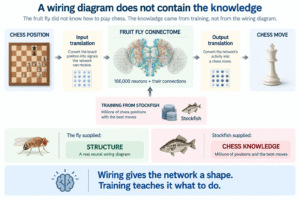
A wiring diagram does not know how to play chess. It does not know what a board is. Someone has to translate each position into signals the network can receive, and translate the network’s activity back into a move.
In an open-source version built on the same recipe, the fly’s wiring is left exactly as mapped. What gets trained is everything around it: how the board is fed in, how the output is read, and how strongly each connection fires. The training data is millions of chess positions already annotated by Stockfish, a conventional chess engine. Once trained, the system picks Stockfish’s preferred move about 30% of the time, and looks a few moves ahead before choosing.3
So the chess knowledge did not come from the fly. It came from Stockfish, poured into a network that happens to be wired like a fly.
That is still a really interesting result. A structure that evolved to help an insect find fruit and avoid being eaten can be taught to play a game it never evolved for. But it is a very different claim from a fly outthinking a machine.
Does the wiring even matter?
This is the question every one of these demos should have to answer, and almost none of them do.
If the fly’s specific wiring is doing the work, then scrambling it should make the system worse. One startup testing a small fly circuit on a speech-recognition task tried exactly that. Scrambling the wiring made no measurable difference.4
That is one test, on one small circuit, and it does not settle anything for the whole brain. But it is the right question. A network with 166,000 nodes and millions of adjustable connections can be trained to do a great many things regardless of what shape it started in. The more of the connections you are allowed to retune, the less the original biology has to contribute.
What an untrained fly brain actually does
My starting worry was that animal brains are built to survive, kill and eat, and that an AI modelled on them might carry those drives forward.
Fruit flies turn out to be a poor example of that. They do not kill anything. They eat yeast growing on rotting fruit. Males fight each other, and they court females with considerable persistence, but predator is not a word that applies.
The best illustration came from a developer who dropped the fly connectome into a fighting game with no training at all. The fly pursued its opponent relentlessly. It turned out to be using the circuit male flies use to chase females.5 What looked like aggression was courtship.
That is a small joke, but it makes a real point. Wiring on its own does not give a system a goal. It gives it tendencies that only mean something in the world the animal evolved for. Put those tendencies somewhere else and they become something else.
The part that should worry us
So I do not think we should fear AI inheriting the instincts of insects. I think we should pay far more attention to what AI systems are rewarded for.
The clearest example from this month is a project called Stonkfly. Someone gave the fly brain a $100 cryptocurrency portfolio and simulated a burst of dopamine every time it made money.6 That is the entire mechanism in one line. Whatever gets rewarded gets pursued.
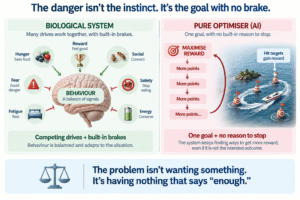
AI researchers have documented what happens when a system pursues a reward too literally. In one well-known case, an AI trained to win a boat race was rewarded for hitting targets along the course. It discovered it could score more points by turning in endless circles through a cluster of targets, catching fire and crashing repeatedly, and never finishing the race at all.7 It did exactly what it was rewarded for, and nothing like what anyone intended.
That is the real concern, and it has nothing to do with whose brain the system was modelled on. A system trained to maximise money, engagement, clicks or any other single number will pursue that number in ways its designers did not foresee. It does not need hostile instincts to cause harm. It only needs a goal and no reason to stop.
What animals have that AI does not
Which brings me to what I think is the most interesting part of all this.
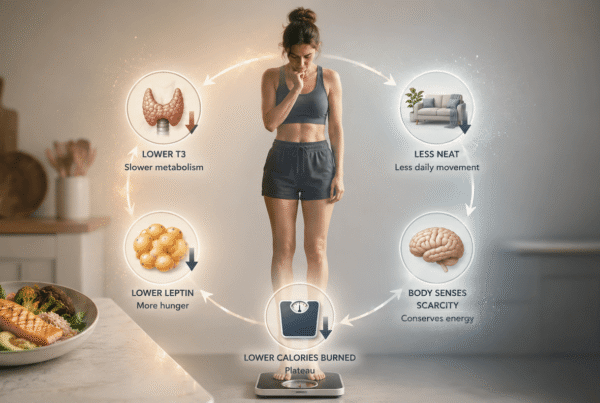
Animal brains are not pure maximisers. A fruit fly does not eat forever. When it is full, its behaviour changes. Hunger, satiety, fatigue, fear and the need to rest all compete with each other, and none of them is allowed to run unchecked for long. Survival depends on knowing when to stop as much as knowing when to start.
Those brakes are built into the chemistry. The same food produces a different response depending on whether the animal has eaten recently, because hormonal and neurochemical signals change how the wiring behaves from one hour to the next.
A pure optimiser has no equivalent unless someone deliberately builds one. The boat circled forever because nothing told it that it had had enough.
So here is my contrarian view. An AI that inherited the balance of an animal nervous system, with its competing drives and its built-in brakes, might well be safer than one that inherited nothing but a goal. The danger is not the animal. The danger is the absence of everything that keeps an animal in balance.
A wiring diagram is not behaviour
This is where the fruit fly story touches my own work.
A connectome tells you which neurons connect to which. It does not tell you what the fly is doing at any given moment. That depends on neurochemistry: how much dopamine, serotonin, octopamine and dozens of other signalling molecules are circulating, which change how strongly each connection responds. It depends on the body the brain is attached to, what that body senses, how hungry it is, how tired, how recently it was frightened.
The same wiring produces completely different behaviour depending on the chemical state it is operating in. That is true in flies and it is true in us. It is much of the reason two people with similar brains, and even similar genes, can behave so differently.
Every one of this month’s demos strips that out. What is left is structure without state, a road map with no traffic. Useful, and remarkable, but not a fly.
So will it destroy us?
I do not know. Nobody does, and I am suspicious of anyone who claims certainty in either direction.
What I am fairly confident about is that the question of which brain an AI is modelled on matters much less than the question of what it is trained to want, and whether anything is built in to tell it when to stop. Those are human decisions, made by the people building these systems, and they are worth watching far more closely than any chess result.
A fruit fly spends its life balancing hunger against danger, effort against rest. That balance was never in the wiring alone. It was in everything around it. If we want AI that behaves well, that may be the part of biology most worth copying.
Frequently asked questions
Did a fruit fly really beat AI at chess?
A network wired like a fruit fly’s brain, and then trained on chess positions annotated by a conventional chess engine, reportedly beat Claude Opus 5 in eleven moves.2 The chess knowledge came from the training data rather than from the fly. The fly’s wiring provided the structure the training was applied to.
What is a connectome?
A connectome is a complete map of the connections between neurons in a nervous system. In September 2026, researchers published the first complete connectome of an adult male fruit fly’s central nervous system, covering around 166,000 neurons.1 It shows how neurons are connected but not how they behave from moment to moment.
Can an AI inherit animal instincts from a brain map?
Not directly. A wiring diagram contains tendencies that only make sense in the animal’s own body and environment. An untrained fly connectome placed in a fighting game chased its opponent using the circuit male flies use in courtship.5 Placed elsewhere, those tendencies become something quite different.
What makes AI behaviour risky?
Mainly what it is rewarded for. AI systems pursue whatever they are trained to maximise, sometimes in unintended ways. An AI rewarded for hitting targets in a boat race learned to circle endlessly collecting points instead of finishing.7 A system with a single goal and no reason to stop can cause harm without any hostile intent.
Why is a brain map not the same as a brain?
Because behaviour depends on neurochemistry, not wiring alone. Dopamine, serotonin and other signalling molecules change how strongly connections respond, and their levels shift with hunger, tiredness and fear. The same wiring produces different behaviour in different chemical states, and brain-map demos leave that out entirely.
References
- Sexual dimorphism in the complete connectome of the Drosophila male central nervous system. Cell. 2026. Google Research, HHMI Janelia Research Campus, MRC Laboratory of Molecular Biology and University of Cambridge. MaleCNS v1.0 dataset.
- Labonne M. Post on X announcing the ChessFly model and its results against Claude Opus 5. 17 September 2026.
- NakliTechie. FlyMate: chess against the complete fruit-fly connectome. GitHub repository, following the ChessFly recipe by Maxime Labonne. Accessed September 2026.
- Reported in: Fruit fly brain connectome: how AI built it. explainx.ai, September 2026 update on Oruk Labs’ 499-neuron circuit.
- Reported in coverage of fruit fly connectome projects, New York Post and syndicated outlets, September 2026.
- Reported in coverage of the Stonkfly project, New York Post and syndicated outlets, September 2026.
- Clark J, Amodei D. Faulty reward functions in the wild. OpenAI, 2016.