Farmed salmon contains chemicals like dioxins and PCBs. What has changed is how much. Levels in farmed salmon have fallen substantially over the last twenty years, to the point where wild salmon now measures higher. But the amount considered safe to eat has fallen faster still, and European food safety scientists now say the average person is already over the limit from their diet as a whole. And the change that cleaned up farmed salmon came at a cost most people don’t know: it roughly halved the omega-3 you are most likely eating the salmon for.
What is actually in it
Three groups of contaminants matter in salmon.
- Dioxins. By-products of combustion and industrial processes, including paper bleaching and waste incineration. They settle into water and soil and work their way up the food chain.
- PCBs. Industrial chemicals once used in electrical equipment and banned decades ago, which have not gone anywhere. The dioxin-like ones behave in the body much as dioxins do.
- Mercury. Occurs naturally and concentrates in large, long-lived predatory fish such as sharks. Salmon is low in it.
The first two matter most for salmon, and they share one property. They dissolve in fat rather than water. They collect in the fatty tissue of whatever eats them, and they stay there.
Why dioxins are a different kind of problem
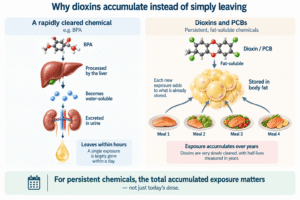
Most chemicals the body encounters get processed and excreted. BPA, for example, is cleared by the liver within hours, which I covered in the article on BPA in pregnancy. Dioxins are the opposite. They resist breakdown, store in body fat, and take several years to leave.
That changes how exposure works. With a rapidly cleared chemical, what matters is how much you are exposed to today. With dioxins, what matters is everything you have accumulated over years, because very little of it has left. Each serving adds to a total rather than passing through.
The most studied dioxin is classified as a known human carcinogen. Long-term exposure also affects the immune, nervous and endocrine systems, and reproduction.4
The good news: levels have fallen
Norway is required under EU rules to monitor its farmed fish, and it has sampled thousands of salmon since the late 1990s. Dioxins, dioxin-like PCBs and mercury in Norwegian farmed salmon all fell over that period.1
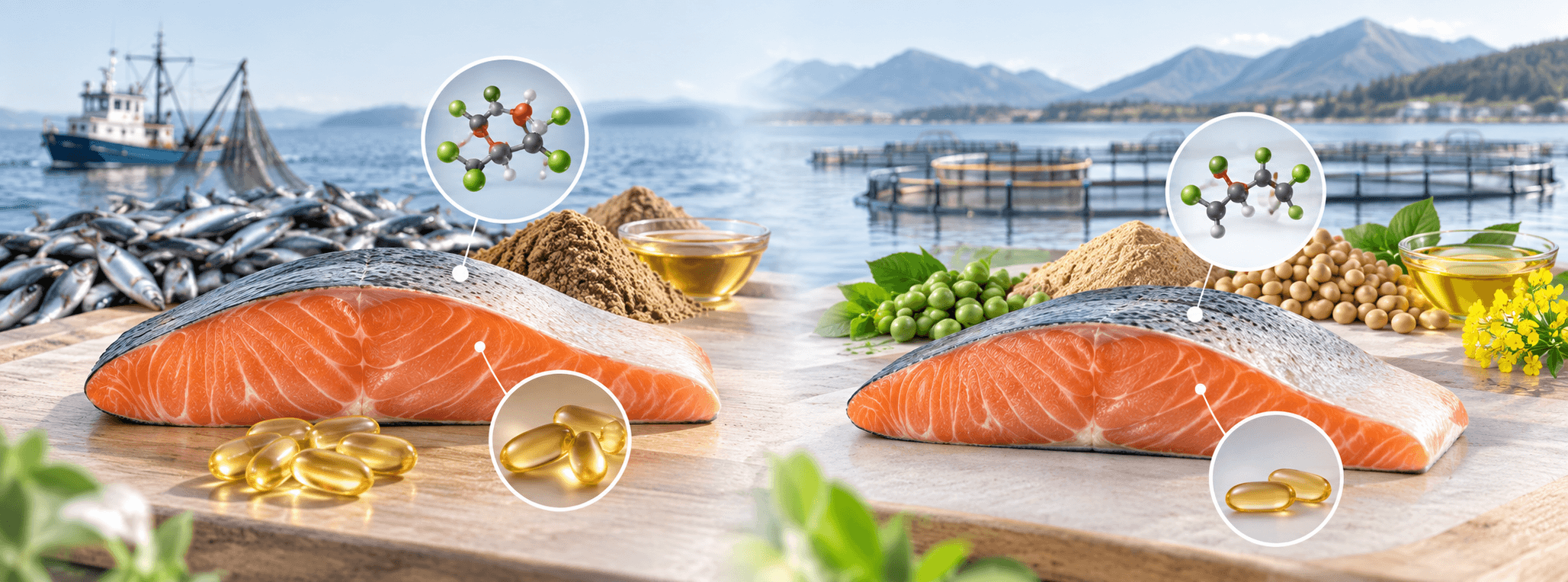
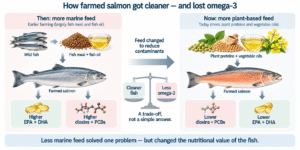
The reason is the feed. Salmon take in these chemicals through what they eat, and farmed salmon used to be fed largely on fish meal and fish oil made from wild fish, some of it caught in heavily polluted waters. The industry has progressively replaced much of that with plant proteins and vegetable oils. Plants are not a meaningful source of dioxins, so less went in and less came out.
The result is a reversal of what used to be true. A comparison of farmed and wild Atlantic salmon found dioxins, dioxin-like PCBs and mercury about three times higher in the wild fish.2 Both were within legal limits.
The less reassuring news: the limit moved further
In 2018 the European Food Safety Authority reassessed dioxins and dioxin-like PCBs and cut the tolerable weekly intake to one seventh of the previous level.3 The main reason was new data on human health effects.
The effect the new limit was built on was reduced sperm quality in boys who had been exposed before birth and through breastfeeding. So the safety threshold for these chemicals is based on harm that occurs during pregnancy and early infancy, which makes them directly relevant to anyone pregnant or planning to be.
Then in late 2025, EFSA published a draft opinion proposing to cut the limit again, to less than a third of the 2018 figure. It stated that dietary exposure across Europe already exceeds the proposed new limit in every age group.4
To be fair to the other side, this is contested. The UK’s scientific committee on food toxicity considered the 2018 cut possibly too cautious and questioned the key study behind it. But the direction of travel is clear. Every reassessment of dioxins has concluded they are harmful at lower levels than previously thought.
It is worth being clear about what a safety limit actually is. It is a regulatory judgement about how much exposure is acceptable across a whole population, based on the evidence available at the time. It does not mark the point below which a chemical stops having any effect. For some substances, authorities decline to name a safe level at all: no safe blood lead level has been identified in children, and for chemicals that damage DNA directly, regulators aim for exposure as low as reasonably achievable rather than setting a threshold. Limits are also averages. They cannot account for the person whose genetics, nutrient status or existing chemical load leaves them less able to clear a particular compound.
My own view is that for persistent chemicals like dioxins, which accumulate over a lifetime, the sensible aim is to keep exposure as low as you reasonably can. A legal limit tells you what a regulator will tolerate. It is not an assurance that less would not be better.
So both statements are true at once. Farmed salmon contains far less dioxin than it did. And the amount of dioxin considered acceptable has fallen faster than the amount in the fish.
The trade-off nobody mentions
Replacing fish oil with vegetable oil removed contaminants. It also removed omega-3.
EPA and DHA, the long-chain omega-3 fats that are the main nutritional reason to eat oily fish, come almost entirely from marine sources. Vegetable oils do not contain them. Researchers who analysed over three thousand Scottish farmed salmon between 2006 and 2015 found EPA and DHA fell substantially over that period, to the point where you would need to eat roughly double the portion to get the same amount you would have from a single serving in 2006.5
The same shift reduced selenium, iodine and vitamin D in the feed.
Farmed salmon is still a good source. It remains one of the richest sources of EPA and DHA available, ahead of most other fish and every land animal, and some farmed salmon contains considerably more than wild Pacific salmon.5 But it is not the product it was, and it varies considerably between producers depending on how much fish oil goes into the feed.
The feed chemical that got banned
Fish meal and fish oil are extremely prone to going rancid, and can even catch fire during long sea voyages. For decades they were stabilised with an antioxidant called ethoxyquin.
Ethoxyquin had originally been registered as a pesticide. It entered animal feed under an old authorisation that predated modern safety assessment, and sat there largely unexamined for decades. Almost nobody measured it in fish.
When European regulators finally assessed it properly, they could not conclude it was safe. One of its breakdown products could not be ruled out as damaging to DNA, and an impurity left over from manufacturing was a recognised possible mutagen. The EU suspended its use in all animal feed in 20176 and formally refused authorisation in 2022.7 Norway follows EU feed rules.
That is a regulatory failure that took far too long to correct. It is also, eventually, a correction. This is an example of how a chemical can pass through the food system for decades on the strength of an old approval.
What the pregnancy advice says
Food Standards Australia New Zealand advises that there is no need for anyone, including pregnant and breastfeeding women, to stop eating fish.8 The recommendation is two to three serves a week, because the omega-3 in fish supports the baby’s brain and eye development.
The restriction is on a small number of large predatory fish that accumulate mercury: shark (sold as flake), swordfish, marlin, orange roughy and catfish. Atlantic salmon is on the low-mercury list.
The real pregnancy concern with salmon is listeria, and it applies to cold-smoked salmon and raw fish in sushi and sashimi rather than to cooked salmon.
Where I would add caution to the official advice is dioxins, given that the current safety limit is based on effects of exposure during pregnancy and breastfeeding. That is an argument for variety and moderation.
How to eat salmon sensibly
- Vary your fish. Rotating species spreads exposure rather than concentrating it from one source.
- Favour small oily fish. Sardines, anchovies and mackerel sit lower on the food chain, accumulate less, and are excellent sources of omega-3.
- Trim the fat and remove the skin. Because these chemicals concentrate in fat, the belly flap, the fatty layer under the skin and the skin itself carry more than the lean flesh.
- Grill, bake or roast on a rack so fat drains away rather than being eaten with the fish.
- Keep portions reasonable. Two to three serves a week is the recommended amount.
- In pregnancy, avoid cold-smoked salmon and raw fish for listeria rather than contaminant reasons.
Frequently asked questions
Does farmed salmon contain dioxins?
Yes. Farmed salmon contains dioxins and dioxin-like PCBs, which it takes in through its feed. Levels have fallen considerably since the late 1990s as fish meal and fish oil were partly replaced with plant ingredients,1 and are now within legal limits.
Is wild salmon safer than farmed salmon?
Not in terms of contaminants. A comparison of Norwegian Atlantic salmon found dioxins, dioxin-like PCBs and mercury about three times higher in wild fish than farmed.2 Farmed salmon also often contains more omega-3 than wild Pacific salmon, although that varies between producers.
Why do dioxins matter if levels are below the legal limit?
Because the limit keeps moving. The European Food Safety Authority cut the tolerable weekly intake to one seventh of its previous level in 2018,3 and a 2025 draft proposes cutting it further, stating that dietary exposure across all age groups already exceeds the proposed new level.4 Dioxins also accumulate in body fat over years, so the total matters more than any one meal.
Is there a safe level of dioxin?
Regulators set tolerable intake limits, but these are judgements about acceptable exposure across a population rather than a line below which dioxins have no effect, and they have been lowered repeatedly as evidence has accumulated.3,4 Because dioxins build up in body fat over years, the practical aim is to keep exposure as low as reasonably possible rather than to stay just under a limit.
Has farmed salmon lost its omega-3?
Much of it. Between 2006 and 2015, EPA and DHA in Scottish farmed salmon fell to the point where a double portion was needed to get the amount a single 2006 portion provided.5 It remains one of the best available sources, ahead of most fish and all land animals.
Is ethoxyquin still used in fish feed?
Not in the EU or Norway. Its authorisation as a feed additive was suspended in 20176 and formally refused in 2022,7 after regulators could not rule out harm from one of its breakdown products and an impurity from its manufacture.
Can I eat salmon while pregnant?
Yes. Australian guidelines recommend two to three serves of fish a week in pregnancy, and Atlantic salmon is on the low-mercury list.8 Avoid cold-smoked salmon and raw salmon for listeria risk. Varying the fish you eat, and trimming fat and skin, reduces dioxin exposure without losing the omega-3 benefit.
How can I reduce contaminants when eating salmon?
Remove the skin and the fatty layer beneath it, since these chemicals concentrate in fat. Cook on a rack so fat drains away. Rotate between different fish rather than relying on one, and include small oily fish such as sardines and mackerel, which sit lower on the food chain.
References
- Nøstbakken OJ, et al. Contaminant levels in Norwegian farmed Atlantic salmon (Salmo salar) in the 13-year period from 1999 to 2011. Environment International. 2015. PMID 25454244.
- An update on the content of fatty acids, dioxins, PCBs and heavy metals in farmed, escaped and wild Atlantic salmon (Salmo salar L.) in Norway. 2020. PMID 33352671.
- EFSA Panel on Contaminants in the Food Chain. Risk for animal and human health related to the presence of dioxins and dioxin-like PCBs in feed and food. EFSA Journal. 2018;16(11):5333.
- EFSA Panel on Contaminants in the Food Chain. Draft scientific opinion on dioxins and dioxin-like PCBs in feed and food, released for public consultation, November 2025.
- Sprague M, Dick JR, Tocher DR. Impact of sustainable feeds on omega-3 long-chain fatty acid levels in farmed Atlantic salmon, 2006–2015. Scientific Reports. 2016;6:21892.
- Commission Implementing Regulation (EU) 2017/962 suspending the authorisation of ethoxyquin as a feed additive for all animal species and categories. Official Journal of the European Union. L 145, 8 June 2017.
- Commission Implementing Regulation (EU) 2022/1375 concerning the denial of authorisation of ethoxyquin as a feed additive.
- Food Standards Australia New Zealand. Mercury in fish. foodstandards.gov.au.